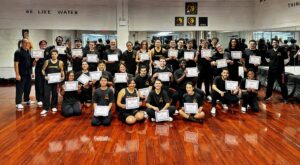
Martial arts is far more than a form of combat — it’s a way of life, a discipline that interconnects body, mind, and spirit. From ancient masters to modern legends, certain individuals have reshaped the art, philosophy, and global understanding of martial arts.
At our school, where we teach Jeet Kune Do (JKD) — the art founded by Bruce Lee — we believe that understanding these figures deepens both your understanding and appreciation of what martial arts truly represents.
Below, we explore some of the most influential martial artists of all time — and the lessons they continue to teach us.
1. Bruce Lee – The Founder of Jeet Kune Do
No list of influential martial artists could begin without Bruce Lee. More than a fighter, Lee was a philosopher, actor, and innovator who revolutionized how the world viewed martial arts.
Why Bruce Lee changed everything:
- Founder of Jeet Kune Do (“The Way of the Intercepting Fist”), a system emphasizing adaptability, freedom, and self-expression.
- Broke down barriers between East and West, bringing martial arts to Hollywood and the mainstream.
- Advocated for efficiency and practicality over rigid forms — “Absorb what is useful, reject what is useless, add what is essentially your own.”
- Inspired generations of martial artists, MMA fighters, and fitness enthusiasts worldwide.
At our school, we follow his principles — not simply mimicking movement, but by each student developing his or her own way. Every movement, from footwork to striking, is a reflection of Lee’s belief that martial arts is a path toward self-actualization.
2. Ip Man – The Grandmaster of Wing Chun
Ip Man (Yip Man) was a legendary master of Wing Chun, known for his fluid, close-range fighting style and centerline theory. He was also one of Bruce Lee’s teachers before he developed Jeet Kune Do.
Key contributions:
- Modernized and popularized Wing Chun, an art emphasizing speed, structure, and economy of motion.
- Mentored a generation of practitioners, including Bruce Lee, who carried Ip Man’s teachings into new territories.
- Became a symbol of Chinese martial spirit, depicted in the globally acclaimed Ip Man film series.
Through Ip Man, we see how lineage connects technique with philosophy — a bridge between tradition and innovation.
3. Hélio Gracie – The Father of Brazilian Jiu-Jitsu
In Brazil, Hélio Gracie transformed martial arts forever. Unable to rely on strength, he refined Jiu-Jitsu into a system based on leverage, timing, and efficiency — creating what we now know as Brazilian Jiu-Jitsu (BJJ).
Why his impact endures:
Created a martial art where smaller practitioners could defeat larger opponents.
Influenced the rise of mixed martial arts (MMA) and the Ultimate Fighting Championship (UFC).
Emphasized control, patience, and precision.
4. Chuck Norris – The Bridge Between East and West
Chuck Norris is one of the few martial artists whose influence extends beyond the training floor to global pop culture. A skilled Tang Soo Do and Karate champion, Norris brought authenticity and discipline to Western martial arts in film and competition.
His legacy:
- One of the first Western martial artists to earn a black belt in multiple disciplines (Tang Soo Do, Karate, and later Brazilian Jiu-Jitsu).
- Founded Chun Kuk Do, a system emphasizing respect, discipline, and self-improvement.
- Inspired countless students worldwide through his films, teachings, and advocacy for martial arts education.
5. Anderson Silva – The Modern Martial Artist
Known as “The Spider,” Anderson Silva is one of the greatest fighters in UFC history. His fluid, unpredictable striking and calm demeanor inside the octagon exemplify martial artistry in motion.
Why Silva is influential:
- Longest-reigning UFC Middleweight Champion in history.
- Combined techniques from Muay Thai, Boxing, Capoeira, and Brazilian Jiu-Jitsu.
- Represented martial arts as a discipline of intelligence, not just aggression.
Silva reminds us that even in modern combat sports, martial arts remains an art — one defined by adaptability, respect, and creativity.
6. Gichin Funakoshi – The Father of Modern Karate
Gichin Funakoshi brought Karate from Okinawa to Japan and helped systematize it into a discipline of moral and physical cultivation.
Key principles:
- Founded Shotokan Karate, one of the world’s most practiced styles.
- Emphasized the philosophical aspect of training — humility, respect, and lifelong learning.
- Believed “the ultimate aim of Karate lies not in victory or defeat, but in the perfection of the character of its participants.”
His teachings resonate deeply with all martial arts — a reminder that the greatest victories happen within.
7. Morihei Ueshiba – The Founder of Aikido
Morihei Ueshiba, known as O-Sensei, founded Aikido, an art of harmony and redirection. He believed that true mastery lies in neutralizing aggression, not amplifying it.
His philosophy:
- Aikido is the “Way of Harmony” — blending with an attacker’s energy rather than clashing against it.
- Emphasized spiritual and moral development alongside physical skill.
- Inspired martial artists to view combat as a path toward peace, balance, and understanding.
Ueshiba’s wisdom continues to influence all who seek to understand the deeper meaning of martial arts.
Final Thoughts: What These Great Individuals Teach Us
From Bruce Lee’s freedom, to Ip Man’s close-quarter control, Hélio Gracie’s adaptability, and Anderson Silva’s artistry, these figures remind us that martial arts is ever-evolving — a balance of tradition and innovation.
Each of these individuals taught one fundamental truth:
Martial arts is not about domination — it’s about transformation.
At NY Martial Arts Academy, we carry this legacy forward through Jeet Kune Do, training not only to improve physically, but to explore personal growth, adaptability, and truth in combat as well as in life.
Train hard. Think freely. Express yourself.
That’s the true spirit of martial arts — and of Jeet Kune Do.
Call today at 877-TRUE-JKD to take the first step of your journey!